
This is where 24/7 security monitoring becomes critical. In this blog, we explain how continuous monitoring, human-led detection, and rapid response help reduce cyber risk and protect modern businesses from growing threats.
The Reality Modern Businesses Avoid Admitting
Cyber-attacks are not subject to business hours. They pursue opportunity–and business in the daytime makes opportunity every night. Security remains like a 9 to 5 -hour job in most organizations: the alerts have to queue over night, the investigations wait until morning and we will get to it tomorrow is the operating model. The time lapse is not a small inconvenience.
It’s a measurable weakness. In the contemporary world, the largest hazard is not usually a missing instrument, but Latency: the lag between a signal and a choice. Minor irregularities become business incidences when no one is paying attention.
The threat space is not keeping time with your calendar. Credential abuse (22%), exploitation of vulnerabilities (20%), and phishing (16%), are the most frequently used initial access vectors in non-error, non-misuse breaches in Verizon DBIR SMB snapshot. And ransomware is said to be present in 44% of breaches audited. It is not one of those kinds you get to look into later without making a purchase in Timing.
The myth of tomorrow is flawed since attackers possess Persistence and businesses have predictable downtimes: nights, weekends, holidays and understaffed shifts. When you switch off your defense posture past hours then your opponent will come to play the quiet hours game.
Related Article: SOC vs. SIEM vs. MDR: Picking the Right Security Approach for You
Related Article: Choosing the Right MSSP for Your Business: A Comprehensive Guide
What Happens When Security Goes Offline

It is not a scuffle. It is an effective authentication. The user name is authentic. The exercise appears sound on the surface.
To quantify Coverage, they inspect internal portals, cloud consoles, and shared services. They are getting acquainted with the things your identity can access and the things your network permits.
Privilege escalation is not usually in the form of hacking. It appears to be a role playing, an API token, or an account with excessive permissions doing what it can. This is whereby a valid access may be concealed Intrusion.
A huge download is not always a requirement. It is often careful, low volume access, to merge with normal reads.
Another identity, another token, another integration is formed a second access path. Such is the manner of Continuity that attackers develop despite the initial foothold being eliminated.
At dawn, your group witnesses floating signs. But concession has already been made. What you might have done at 2:13 turns into an inquiry at 8:55 – and your choices are worse due to the passage of time.
This is why breaches “grow in silence.” They don’t start large. When initial signals are not decoded promptly, they grow big.
Related Article: Security Operations Center (SOC) 101: A Primer for Business Leaders
Related Article: How MSSPs Can Help Your Business Stay Secure in a Post-Attack World
Modern Attackers Are Quiet, Patient And Fast When It Matters
Attackers are still imagined by many businesses as noisy: software all around, alarm bells ringing, systems breaking down. The contemporary opponents become more and more victorious because they are more normal- they are the ones who merge into the accepted mode of being until they are confident enough to take action.
The DBIR SMB snapshot of Verizon reveals that the initial phases of intrusion can be insidious: credentials and exploitation are the most common entry points. It further states that 60 percent of attacks had a human factor and that the use of third-party doubled to 30 percent. It also points to actual cases of credential reuse on third-party accounts and documents an average of 94 days to fix leaked secrets found on a GitHub account. That is the Exposure time in months.
Related Article: The Role of MSSPs in Cyber Attack Recovery and Prevention
Meanwhile, attackers move swiftly when they choose to move. CrowdStrike states that the average breakout time is 48 minutes and the maximum breakout time was 51 seconds, while 79% of the detections were free of malware. Translation: it is possible to have no malware and an ongoing breach.
Even when zooming out, incident-response reality is sobering. M-Trends 2025 of Mandiant lists a median dwell time of 11 days across the world (in 2023 it was 10). That is the average window intruders must search and mount an attack before they are detected.
Combined, the contemporary trend resembles the following: quiet access, slow learning, fast execution. Defense is not continuous, the attacker gains two benefits simultaneously; being invisible at the start and being fast later.
Why Alerts Don’t Become Action In Traditional Security Models
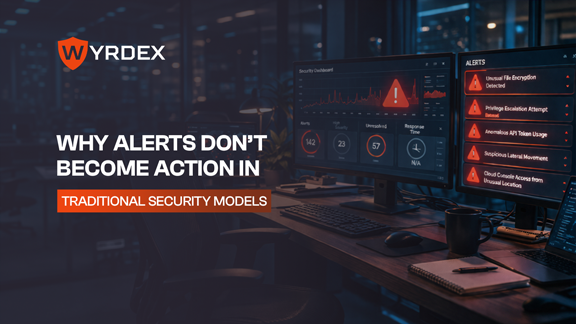
Security is hardly ever letting down at Detection. It does not work with translation: to convert a signal into a choice before the window runs out.
In the tool sense, most organizations monitor logs, EDR alerts, cloud audit trails, firewall events. However, unless there is a manned operation capable of investigating and responding after hours, those indications do not translate to results. Notifications mount up anonymously. Rules are turned down to minimize noises. Events of high severity are handled as tickets. Leadership views dashboards and thinks Surveillance = protection.
This is the difference between we have tools and we have security operations. The SOC content by Wyrdex provides a definition of a SOC as a staffed operation, 24/7, rapid-response, and threat intelligence. They identified odd file encryption in their SOC 101 example and in a few seconds, an endpoint was isolated, and there was no downtime or loss of data. That is how it appears when an alert is handled as an operational emergency, rather than a task to be performed tomorrow.
That is the reason why SOCaaS and MDR models have increased as well. According to Microsoft, SOCaaS is the third-party cloud service that offers twenty-four-hour monitoring, detection, and response capabilities, where a special team continually monitors an organization. Rapid7 also describes SOCaaS as the outsourced detection and response through a fully managed SOC, but clearly cites faster detection and remediation as the fact that internal teams are stretched in a variety of directions. The MDR guidance provided by Rapid7 further states that MDR is a mixture of technology, human insight and 24/7 coverage, and the human-led investigation and response is the distinguishing factor.
It is not about labels. The point is Response timing. Unless your organization can do something when the incident is small, it is not secure, it is merely not harmed yet.
What 24/7 Monitoring Changes Is Outcomes, Not Optics
The concept of 24-hour watch has been misconstrued as somebody looking at the screens at night. That’s not the goal. The objective is quantifiable results that minimize business impact.
Continuous Monitoring alters the results since it condenses the time and fills the gap between the Awareness and action:
It authenticates that an alert is real as long as it counts.
It has an early so that the blast radius remains small.
It reduces the dwell time by compelling prior investigation.
It changes breach risk into Resilience by eliminating escalation and disruption.
Wyrdex defines a managed SOC as a 24/7 team that oversees IT environments, threat analysis and incident response. Their Managed SOC pages talk about monitoring networks, cloud platforms, endpoints, and applications with SIEM and XDR, and incident response and containment, log management, vulnerability management, compliance reporting, and security automation. They also focus on threat intelligence and automated playbooks in order to minimize dwell time and prevent threats prior to propagation.
This is what makes the 24/7 monitoring to change the story: the question is not how bad it is this morning but Can we stop this before it spreads?
Human-led Monitoring Vs Automated Watching
Automation is essential. The modern telemetry cannot be performed manually by any team at scale. But automation has its limits: automation perceives patterns and thresholds. It doesn’t fully understand business context and intent.
This is why efficient 24-7 protection is a balance between automation and human decision making. The models managed as outlined by large providers always reflect this: Rapid7 puts forward the human-led investigation and response layer in MDR; Huntress outlines the SOC providers as teams that monitor, detect, investigate and respond to threats 24/7, with an emphasis on proactivity and hunting.
The SOCaaS model used by Wyrdex is no different: you pay to have experts monitor your environment 24/7, provisioning SIEM, threat intelligence, and automation, and take action immediately a threat is detected. Their pages about Managed SOC providers talk about certified analysts, threat hunters, and incident responders working round the clock, 24/7/365, with the support of threat intelligence and automation. Also reported are quick onboarding and connectivity with cloud platforms, endpoints and firewalls, frequently in less than two weeks, such that always-on coverage does not imply a lengthy, agonizing implementation.
Here Vigilance ceases to be a slogan. It turns into an ability: a human being capable of saying, this is something that looks permitted, but it is wrong and do something when it is still possible to reverse it.
The Cost Of Not Being Always-on And What Wyrdex Changes
The reason why security operations should be always-on is not panic. It’s economics.
The Cost of a Data Breach Report 2024 by IBM states a global average cost of an attack to be USD 4.88 million and business disruption and post-breach response costs are the main contributors to breach cost. Late detection of intrusion is usually more expensive due to the difficulty in containment, the significant customer impact and the time delay in recovery.
The operational reality established by the prevalence of ransomware and initial access patterns by DBIR is credential abuse, exploitation and phishing are also popular entry points; third parties are increasingly involved; and long remediation periods on leaked secrets can make a single entry an ongoing attack. Delay is expensive.
Wyrdex makes its Managed SOC an operating solution to this time issue: 24/7 threat detection and monitoring via SIEM and XDR, quick incident response, and containment, and threat intelligence with automated playbooks to minimize dwell time. Their descriptions of their services keep stressing real-time detection and fast response, as the distinction between a suspicious login and a crisis is often not to do with technology, but with time.
To come up with a self-test that is practical, ask the following questions
Who authenticates an admin login at the time 2:13 AM and in a few minutes?
Once a workstation starts encrypting files, who isolates it before it is propagated?
When a cloud role unexpectedly has access to sensitive data, who checks the permission path?
In case your internal team is asleep or is busy, who owns it?
Unless you can answer those questions in terms of names and time, the incidence of the Coverage gap is present – and the attacks do not keep office hours.